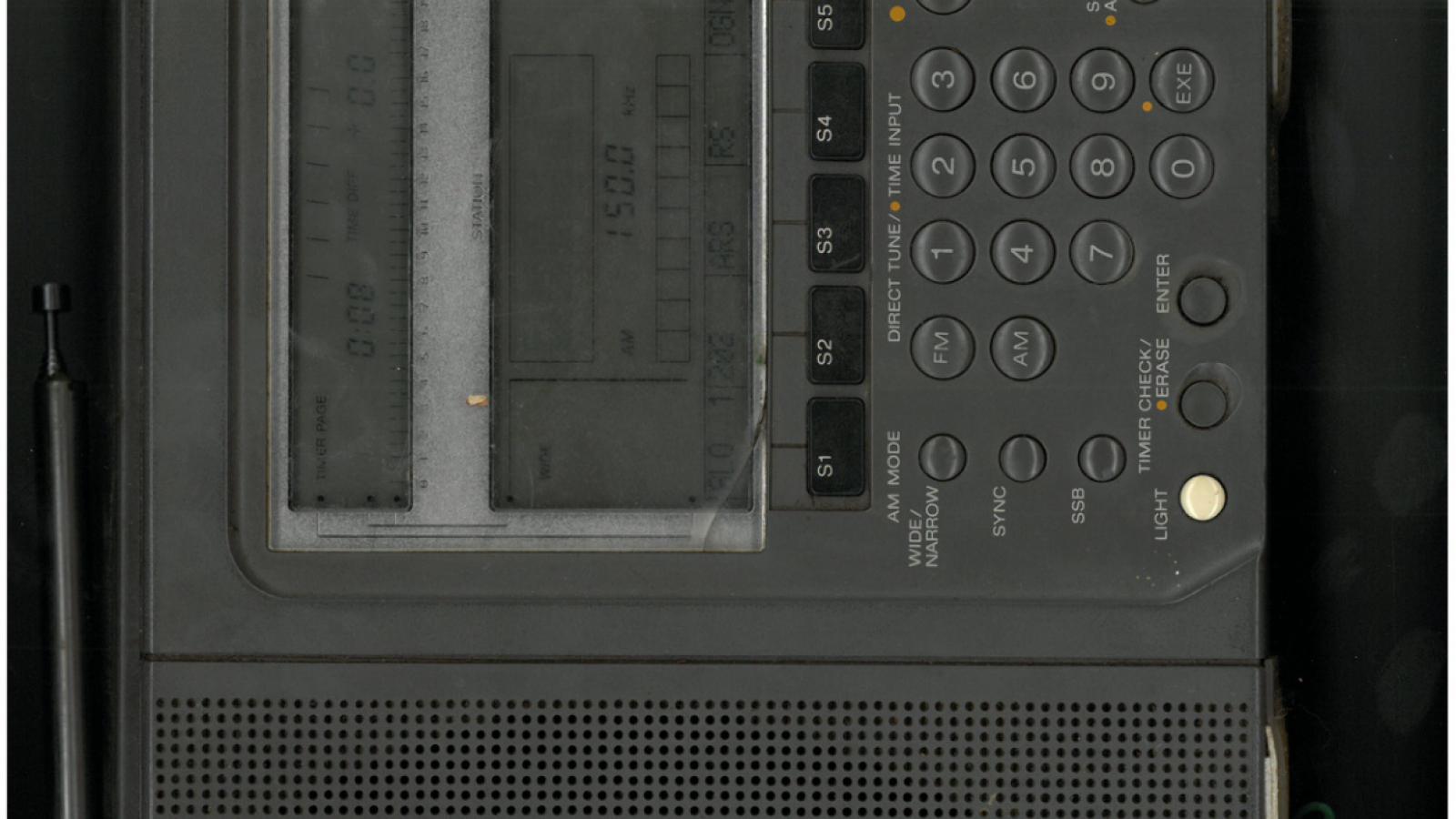
Imaginary Landscapes 4'33" x 4'33" for Sony SW77
The piece takes its inspiration from the compositions of the American composer and anarchist John Cage. It is the first of four pieces, each one dedicated to a different radio wavelength, that is, besides ultra-short wave also medium, long and short wave.
Instead of human stakeholders regulating the strength and modulation of individual radio receivers (i.e. the instrument of the concert), we choose to automatically scan each wavelength as done by SW'77, in accordance with the features of Cage's composition Imaginary Landscapes #4.
This leaves us with an abundance of diverse stations, which in essence only reveal the general poverty of the airwaves. Unfortunately, they can only come to life with each station blaring into the listener's ears. One needs to learn how to listen, even to kitsch.
"Desperate days. Nothing on the airwaves" goes the lyrics of the anarcho-punk band Poison Girls.
The ubiquitous nature of radio junk means either that there is "something on the airwaves" or the lack of silence sift through the scanning of stations, the gaps between songs, the words sought by individual announcers, perhaps even in the unorthodox search for a calm eye of the storm of the wall of noise. The silence as the ambition of Cage's 4'33" is a place of zen in the middle of the noise.
***
A Lament About the Sony SW77 Shortwave Radio Receiver
Sony, Sony,
you tell me so much.
Every night I depend on you,
But you don’t depend on me at all.
You chase away my dark inner thoughts,
But you never answer me.
Sony, Sony
Are you at least listening to me?
Can you really hear me,
What I'm telling you in all honesty?
I'm pretty ill.
I'm healing too slowly, unfortunately.
I need you desperately.
Sony, Sony,
At least hug me tonight.
Let's start over,
This time as equals.
***
The Lament was inspired by the poem Television by the British-American poet Anne Stevenson. See The Paris Review, No. 29, 1963; https://www.theparisreview.org/poetry/4590/television-anne-stevenson. Sony SW77 is one of the best portable shortwave radios ever made.
The irony of the poem is that with the rise of the Internet, the number of shortwave stations and broadcasts has decreased. So Sony, at least on shortwave, has nothing much to say, be it during night or during day. The twentieth century is over. And those of us who have become experts in it precisely because we lived through it have very few people around us to pass on our knowledge.
I had my Sony on 24/7 and I listened to various world radio stations ranging from Australia to Cuba. What is more, in 1995, when I was going through a difficult period of clinical depression, all my ambitions condensed into the desire to lie in a hospital bed and listen to shortwave radio all day and night.
(Published in Poems of the Unknown anarchist, Hirondelle, Ljubljana, 2026).